Archive
AHA MEDIA is very pleased to help announce “Informative Open House – For Carnegie’s Learn to Walk/Run Clinic” in Vancouver Downtown Eastside on Sunday Jan 17, 2010 at 12 Noon
INFORMATIVE OPEN HOUSE
FOR CARNEGIE’S LEARN TO WALK / RUN CLINIC


Preparing you for the 2010 Sun Run
OPEN HOUSE: SUNDAY, JANUARY 17TH FROM 12:00PM – 2:00PM
(GYMNASIUM, CARNEGIE CENTRE)
RUN / WALK CLINIC STARTS SUNDAY, JANUARY 31 – APRIL 25TH
SUN RUN IS MAY 9TH 2010
WHY COME OUT?
13 WEEKS OF FREE TRAINING
NUTRITIONAL EDUCATION
PRE-RUN/WALK SNACKS
FITNESS EDUCATION
MENTORSHIP PROGRAM
FREE ENTRANCE TO THE SUN RUN
LEADERSHIP BY CERTIFIED INSTRUCTORS
GET HEALTHY & SOCIALIZE
FEEL GREAT!
WANT TO LEARN MORE……SEE YOU THERE…….
Walk BC is a joint initiative of the BC Recreation and Parks Association and the Heart and Stroke Foundation of BC & Yukon. Funding is being provided by the Healthy Living Alliance, with support from ActNow BC.
April Smith of AHA MEDIA is very honored to be interviewed by Stephen Quinn – Host of “On the Coast” on CBC Radio, live at the Patricia Hotel on Friday January 15 2010
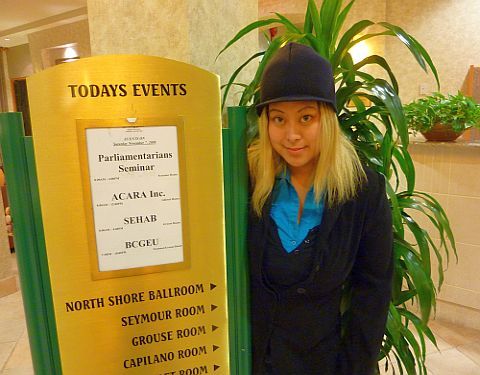

On The Coast


On The Coast is a great way to catch up on the day’s news, and get connected to what’s happening in your neighbourhood. Join host Stephen Quinn between 3:00 and 6:00 p.m.every weekday, and you’ll be right up to date on all the latest sports, weather, traffic, and entertainment from around the Lower Mainland. Stephen Quinn’s Bio
Broadcast Times
- CBC Radio One:
- Weekday Afternoons 3:00 to 6:00 p.m. 88.1 FM and 690 AM in Vancouver.
- ———————————————————————————————————————————————————-
http://www.cbc.ca/bc/community/blog/2010/01/on-the-coast-live-at-the-patricia-hotel-january-15.html

“On the Coast” with host Stephen Quinn will be broadcasting live from Pat’s Pub inside the Patricia Hotel on January 15 from 3 – 6pm. Join us as we explore the cultural profile of the Downtown Eastside, the neighborhood of Strathcona, and even historic Chinatown. Seating will be assigned on a first-come, first-served basis.
Stephen will be talking to “house historian” James Johnstone who will give periodic profiles of specific buildings in Strathcona – when they were built, who lived there, stories of the residents, and where they are now. Photographer Bev Davies will be on hand sharing her memories of how the neighbourhoods used to rock. In the 1970s and 80s, she captured images of old rock and roll venues, as well as the homes of rockers in the area.
—————————————————————————————————————————————————–
April will be on air around 4:40 pm, speaking about AHA MEDIA’s hyper local community event coverage, connections with Vancouver Downtown Eastside (DTES) and Strathcona with neighborhood members and upcoming projects during the Olympics
Below is a photo of April by Photographer Simon Hayter

Below is a photo of April with Members of LifeSkills Centre in Vancouver Downtown Eastside
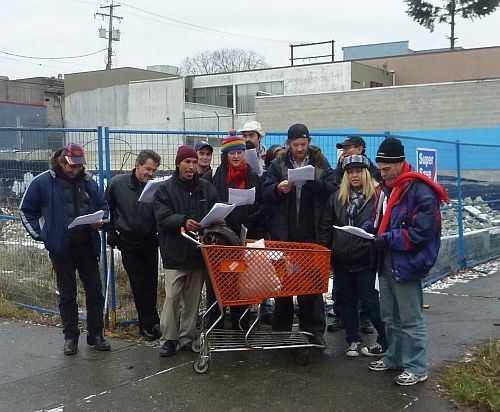
AHA MEDIA is very proud to help Lorraine Murphy – Night manager/space animator of Coworking at BOB ( Building Opportunites with Business ) in Vancouver
April Smith and Peter Davies of AHA MEDIA are very proud to help Lorraine Murphy – AHA MEDIA’s friend, mentor and Night Manager/Space Animator of the new Coworking@BOB space 163 East Pender St in Vancouver’s Chinatown 🙂
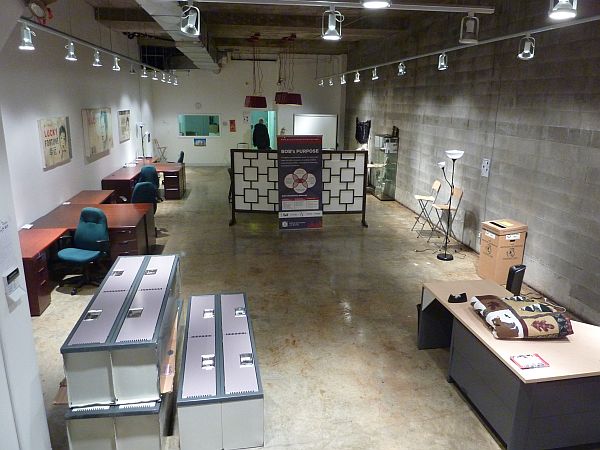
In the photo below, Andrew “Muskie” McKay of BOB explains to Peter Davies of AHA MEDIA the lockers to be installed shortly and available to Coworking@BOB tenants
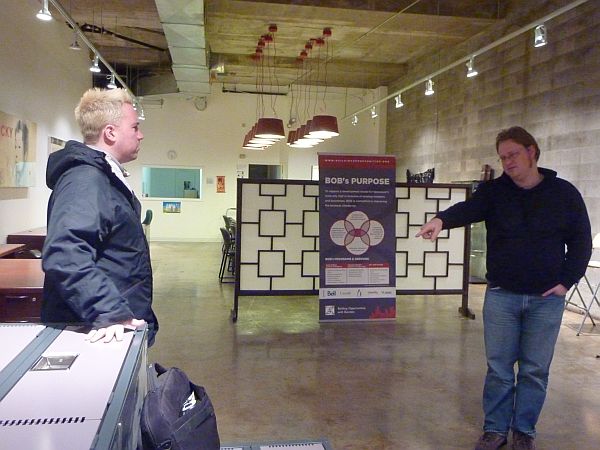
AHA MEDIA will supporting and helping out at Coworking@BOB 🙂
What we’re offering is a work surface, be it a desk, a chair, a table, a couch, or the bay window, wherever you’re most comfortable. Of course we’ll offer wi-fi and other niceties such as an electronic white board and a projector to facilitate discussion and creative thinking. There’s a fridge for your food, a microwave, filtered water cooler, and secure storage for your bike. The price is a flat $200 per month and includes keyless access.
We’re looking for creative professionals, progressive thinkers, the socially responsible and ecologically conscious who want to be surrounded by others of like mind. Folks who want more than a cubicle and a 9 to 5 and dream of bigger things and a better Vancouver to call home. If this sounds like you, contact Andrew “Muskie” McKay 778-328-7672 or write coworking@bobics.org
————————————————————————————————————————————————————
Please read Gillian Shaw of Vancouver Sun article:
By GILLIAN SHAW
Coworking and hotdesking are growing trends with companies and individuals who are abandoning high-priced real estate in favour of more practical – and less pricey – workspace solutions.
With inner city Vancouver home to many independent tech and creative entrepreneurs, it’s a natural for the newly opened coworking@BOB space, a shared work space created by Building Opportunities with Business, a non-profit aimed at supporting business development and job opportunities in the neighborhood.
High-ceiling, spacious and located on the main floor of a building at 163 East Pender St., the shared open space gives tenants desk space, along with chairs, tables, couches and other furnishings that distinguish it from a less inviting cubicle haven. Art on the walls from Vancouver’s Grace Gallery will be rotated regularly.
“We hope that this open shared work space can contribute to the revitalization of the inner-city by providing a space for creative professionals to flourish, for ideas to percolate, to cross pollinate, for businesses to grow, a place where stuff gets done,” reads BOB’s announcement of the new space.
Wi-Fi, a fridge, microwave, filtered water cooler and secure bike storage round out the offerings that come at a flat rate of $200 a month with keyless access to the building.

——————————————————————————————————————————————————————
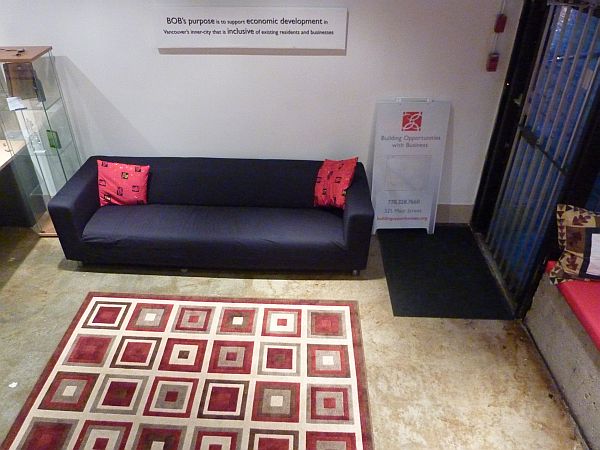
What we’re offering is a work surface, be it a desk, a chair, a table, a couch, or the bay window, wherever you’re most comfortable. Of course we’ll offer wi-fi and other niceties such as an electronic white board and a projector to facilitate discussion and creative thinking. There’s a fridge for your food, a microwave, filtered water cooler, and secure storage for your bike. The price is a flat $200 per month and includes keyless access.
We’re looking for creative professionals, progressive thinkers, the socially responsible and ecologically conscious who want to be surrounded by others of like mind. Folks who want more than a cubicle and a 9 to 5 and dream of bigger things and a better Vancouver to call home. If this sounds like you, contact Andrew “Muskie” McKay 778-328-7672 or write coworking@bobics.org
———————————————————————————————————————————————————–
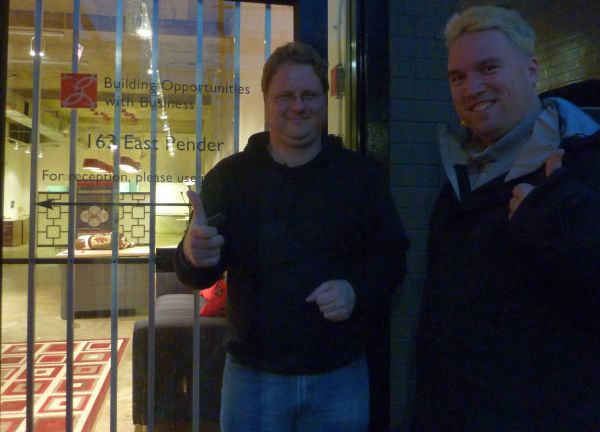
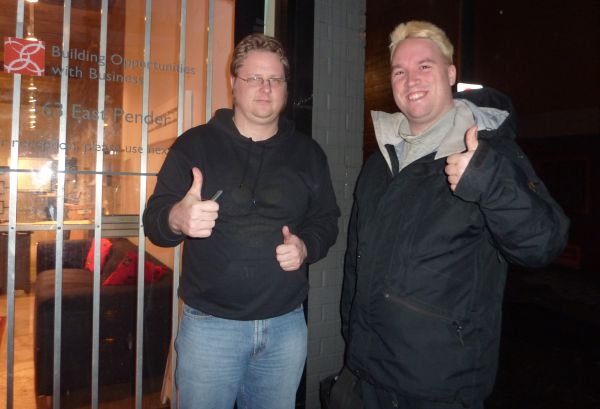
Below are photos of Andrew “Muskie” McKay of BOB and Peter Davies of AHA MEDIA giving the Thumbs Up to Coworking@BOB! 🙂
AHA MEDIA hopes to see you there soon! 🙂
AHA MEDIA films Sam Sullivan, former Mayor of Vancouver speaking about SALOME – Vancouver’s New Heroin Maintenance Trial at VANDU in Downtown Eastside
Sam Sullivan speaks about SALOME –
Vancouver’s New Heroin Maintenance Trial at
VANDU in Downtown Eastside
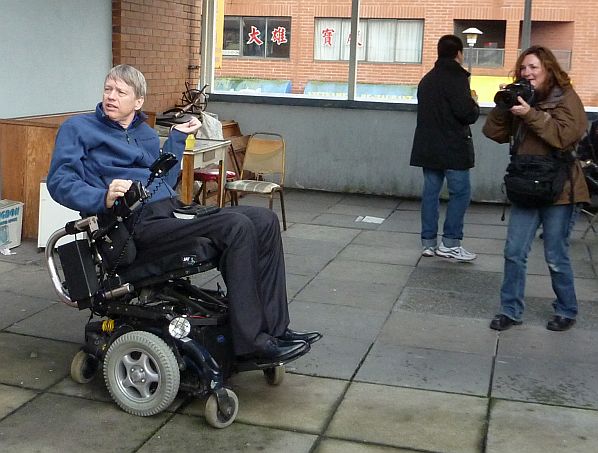
Sam Sullivan with Photographer Kim Stallknecht
—————————————————————————————————————————–
The following text is from http://stopthedrugwar.org/chronicle/s…
The Study to Assess Longer-term Opioid Medication Effectiveness (SALOME) will choose a Downtown Eastside location next month and begin taking applications from potential participants in February, according to a Tuesday press release from the Inner Change Foundation, which, along with the Canadian Institutes of Health Research, is funding the trial. With selection of participants supposed to last only three weeks, that means SALOME could be underway by March.
SALOME will enroll 322 hard-core heroin addicts—they must have been using at least five years and failed other treatments, including methadone maintenance—in a year-long, two-phase study. During the first phase, half will be given injectable heroin (diacetylmorphine) and half will be given injectable Dilaudid® (hydromorphone). In the second phase, half of the participants will be switched to oral versions of the drug they are using.
The comparison of heroin and Dilaudid® was inspired by unanticipated results from SALOME’s forerunner, NAOMI (the North American Opiate Medication Study), which began in Vancouver in 2005 and produced positive results in research reviews last year. In NAOMI, researchers found that participants could not differentiate between heroin and Dilaudid®. The comparison of success rate among injection and oral administration users was inspired by hopes of reducing rates of injection heroin use.
SALOME was also supposed to take place in Montreal, but Quebec provincial authorities effectively killed it there by refusing to fund it. SALOME researchers have announced that it will now proceed in Vancouver alone.
With an estimated 5,000 heroin addicts in the Downtown Eastside and a municipal government that has officially embraced the progressive four pillars approach–prevention, treatment, harm reduction, and law enforcement—to problematic drug use, Vancouver is most receptive to such ground-breaking research. It is also the home of Insite, North America’s only safe injection site.
The NAOMI and SALOME projects are the only heroin maintenance programs to take place in North America. Ongoing or pilot heroin maintenance programs are underway in Britain, Denmark, Germany, the Netherlands, Spain, and Switzerland.
———————————————————————————————————————–
In the following 7 videos, Sam Sullivan, former Mayor of Vancouver talks about SALOME – Vancouver’s New Heroin Maintenance Trial and other things to Members of VANDU and Ann Livingston in Vancouver Downtown Eastside
Videos by April Smith of AHA MEDIA on a New Media camera – Kodak Zi6. AHA MEDIA is about exploring mobile media production through New Media cameras. For a better quality version of this video, please DM April Smith @AprilFilms on Twitter or Facebook.com/AprilFilms
——————————————————————————————————————————–
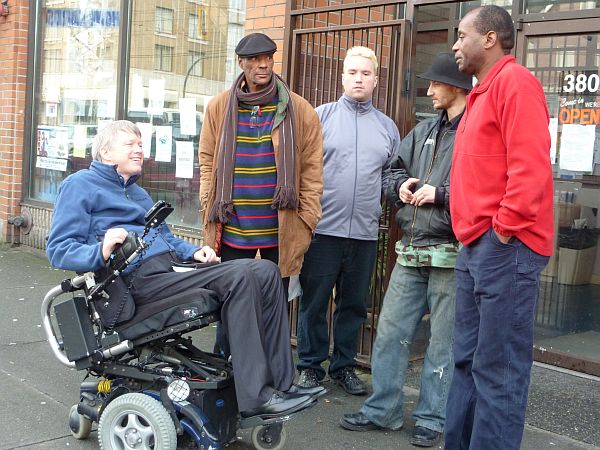
Below is a photo of Sam Sullivan – Former Mayor of Vancouver, Richard Cunningham of VANDU, Peter Davies of AHA MEDIA, Robert Vincent – President of VANDU, Hugh Lampkin – Vice President of VANDU
AHA MEDIA thanks Gary Shilling for his article “Tactics for Democratizing Media During the Olympics and Beyond” in Vancouver Observer
AHA MEDIA thanks Gary Shilling for his article below
Tactics for Democratizing Media During the Olympics and Beyond
Hendrik Beune walks into the cafeteria at the Carnegie Centre in
Vancouver, scratches his cell phone number on his business card and
passes it over to me. The back of the card has an imprint: Bioluminous
Solutions = ethological reporting! (his exclamation mark). He explains
its meaning as, "Observing how something relates to its environment is
like finding sources of light in the dark." Beune and April Smith are
directors of AHA Media, self-described hyper local citizen
journalists. "My wish", Smith says, "is that AHA Media be a democratic
system that is made for messages from the Downtown East Side."

Smith and Beune have deep ties to the community in the Downtown
Eastside (DTES) of Vancouver. They believe that the democracy of
information, new media, and social media are good things for this
community of marginalized residents. "We can support each other by
showing what is happening in the DTES and broadcast it out on a local
level, national level, and to the world," says Smith. They both agree
that this is especially important during the Olympics. John Douglas, a
poet working with AHA Media doesn't have much faith in CanWest and
other mainstream media portraying what will be happening on the
streets of Vancouver during the Olympics. "According to them, the
'world is coming here to party'. My take on that as a veteran Single
Room Occupancy inmate is that the rich 5% of the world are coming here
to party."

Single Room Occupancy (SRO) accommodation in the DTES is in disarray.
Douglas explains that he lives in a building where there is no
security. Anything of value that is left in his room will be taken the
moment he leaves. Given the opportunity, he'd like to put his poetry
online, but he won’t risk having a computer. Beune sees bridging the
digital divide in the community a key for reaching those in SROs and
aboriginal youth.

The W2 Community Media Centre in the massive Woodwards redevelopment
is helping bridge the divide. The result of persistent of strong
community advocacy, W2 is poised to become a cultural hub for the
arts, community groups, and residents in Vancouver. Construction
delays have slowed the opening of the Centre in the heritage portion
of the development, and in the interim it operates out of a space
across the street. They're in the process of getting ready for the
Olympics.

"W2 is all about using intelligent tactics to provide a place for
Vancouverites to tell their stories", says Irwin Oostindie, executive
director. Although partially embedded in the Olympics in their
relationship with the Cultural Olympiad, they are comfortable with the
dialogue that will result from the games. "We're an independent
cultural institution that provides guaranteed access for its citizens
for training, access, broadcast, and sharing their stories," says
Oostindie. With partners in alternative, independent, and citizen
journalism, they expect to be here long after the Olympics leave.

Global marquee events such as the Olympics create complex tensions
within a host city such as Vancouver. This tension is manifest on the
streets of the city, within the venues of the site, and in the
critical and celebratory conversations that take place around the
event. Beune believes there will be demonstrations at the Games about
free speech, and media activist groups have plans to be there.

Franklin Lopez moved to Vancouver in 2005 just as he got a job with
Democracy Now in New York. But he fell in love with the mountains and
came back. He is helping organize people to cover the protests. Lopez
has ties into the activist community and experience at a number of
convergence type events such as the upcoming Olympics. He's involved
with the Vancouver Media Coop and is setting up media spaces to
support incoming media independents. "As part of the activist
community", he notes, "We have ties that have developed over the years
that connect us into what is happening on the street. Just like
mainstream journalists have relationships with the police, and
corporations."

Lopez has mentored Smith and other members of the AHA Media Group.
She’s grateful: "Frank's been instrumental in us forming AHA Media. He
said get online, be independent, report on issues, and the stories
that you want to tell. And don't be afraid of what people say. It can
be good, bad, it can be ugly. If you get a reaction, it means you've
done your work."

In addition to his work with AHA Media, Beune sits on the board of the
Pivot Legal Society, and is part of the legal observer program created
in partnership with the BC Civil Liberties Association. There are
about 200 people trained to observe and record situations with video
and still photography. Besides supporting alternative media, Hendrik
sites another important task: "We have a particular interest in
looking out for 'agent provocateurs' as they are called. They are
people put into the protests to create a ruckus. Then the authorities
move troops in and create even more chaos derailing protest. So,
whenever they disrupt us, we are going to hold them responsible."

It's only natural to expect alternative media to emerge around the
Olympics, but community media is not a new phenomena. Sid Chow Tan has
volunteered within community television for nearly 25 years. According
to Tan, "Canada has played a central role in the development of
community television and is considered by many to be the birthplace of
community broadcasting." The Canadian Broadcast Act clearly states
that our broadcast system is to be composed of public, private, and
community elements—essential for maintaining and enhancing our
national identity and cultural sovereignty.

The community trust of the right to broadcast is currently under the
control of major cable operators in the country. Eight hundred million
dollars in public money has been handed out to cable companies over
the past 10 years, with approximately $60 million going to Rogers and
Shaw in Metro Vancouver. And yet, these companies have little
accountability to the community. Tan is dismayed, "There is no logic
when community programming produced by volunteers is only available by
subscribing to a corporate service."

Cultural institutions such as W2 are looking to fill the gap left by
the increasing corporatization of community media. When it opens in
the historic Woodward's building, the W2 Community Media Arts Society
will be operating a multipurpose multi-platform media arts facility,
including live performance, print, radio, television and new media.
"We're looking at building a media centre for the citizens of
Vancouver. We'll be here in 2010 and 2020 and beyond," says Oostindie.

As mainstream media focuses on counting gold, silver, and bronze
medals, community media in Vancouver looks to document the voice of
the people within their neighbourhoods. Beune cautions, "The IOC has
no responsibility to any legacy, they're not affected by the
neighbourhood and they don't value the assets of our community. We
want to stress the benefits of people working together. My philosophy
is be happy with what you've got. If you have enough be content. If
you have more — share." The stories gathered by the community will be
plentiful and shared with the world.
Follow Us!


