Archive
AHA MEDIA is very pleased to learn how to create Experimental Film loops from Filmmaker David Rimmer – Pioneer of moving images at Interurban Gallery in Vancouver Downtown Eastside
AHA MEDIA is very pleased to learn how to create Experimental Film loops from Filmmaker David Rimmer – Pioneer of moving images at Interurban Gallery in Vancouver Downtown Eastside
David Rimmer http://www.DavidRimmerFilm.com
——————————————————————————————————————————————————————
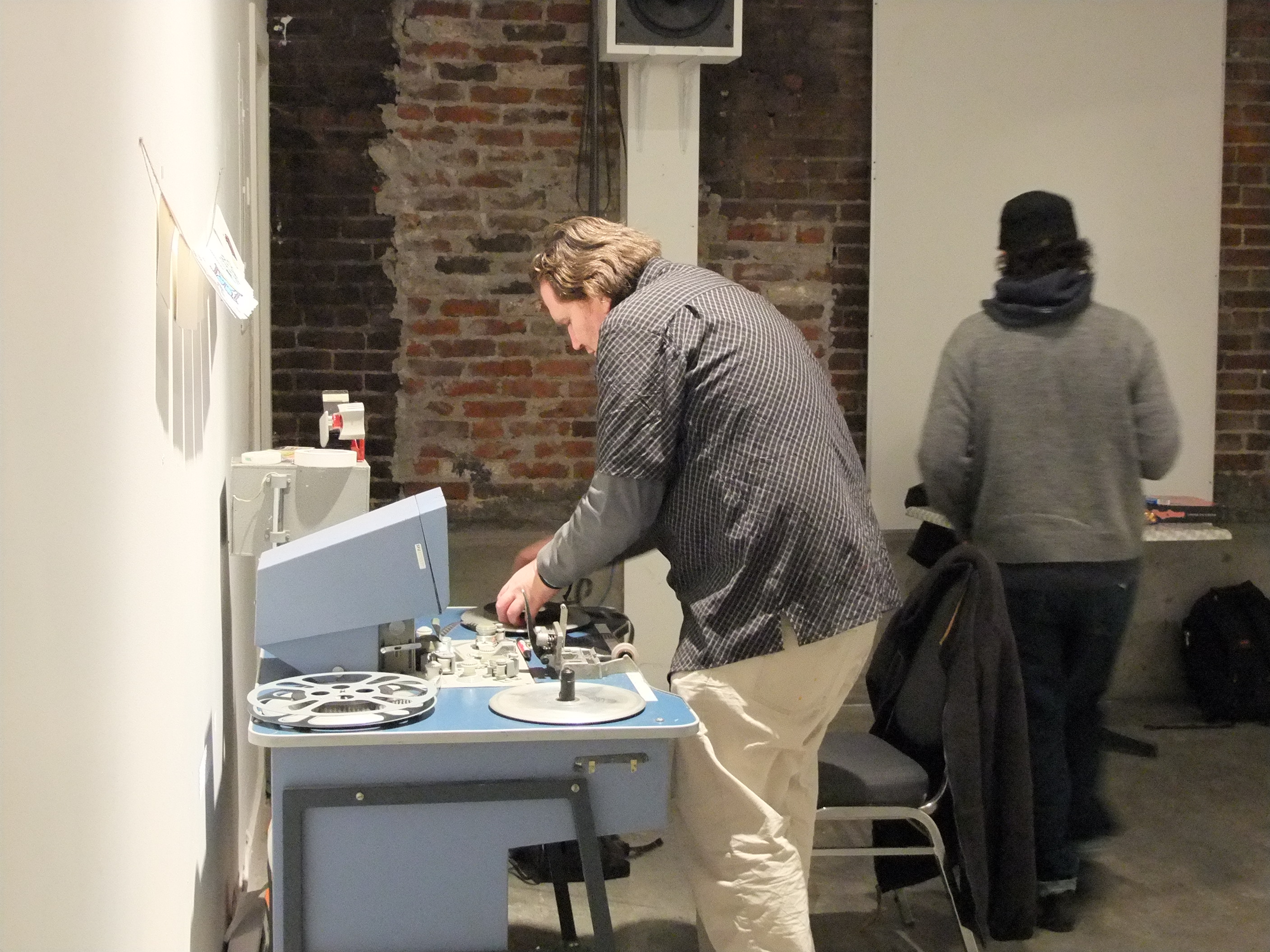
Below is a photo of James Diamond, Frederick Cummings learning to splice 16 mm films from our teacher David Rimmer 🙂

———————————————————————————————————————————————————
In this video, April Smith of AHA MEDIA is helped by Frederick Cummings, James Diamond, Christoph Runne with stretching out a very long loop of 16mm film with our teacher David Rimmer sitting and looking on.
(No Audio in this video)
This video was filmed by Richard Czaban of AHA MEDIA on a New Media camera Fujifilm S200EXR. AHA MEDIA is about exploring mobile media production through New Media cameras. For a better quality version of this video, please DM April Smith @AprilFilms on Twitter or Facebook.com/AprilFilms
——————————————————————————————————————————————————————–
In this video, April Smith of AHA MEDIA learns how to splice 16mm film by Frederick Cummings, James Diamond, with our teacher David Rimmer sitting and looking on.
This video was filmed by Richard Czaban of AHA MEDIA on a New Media camera Fujifilm S200EXR. AHA MEDIA is about exploring mobile media production through New Media cameras. For a better quality version of this video, please DM April Smith @AprilFilms on Twitter or Facebook.com/AprilFilms
———————————————————————————————————————————————————-
In this photo, is Frederick Cummings with James Diamond making experimental film loops with 16mm films.
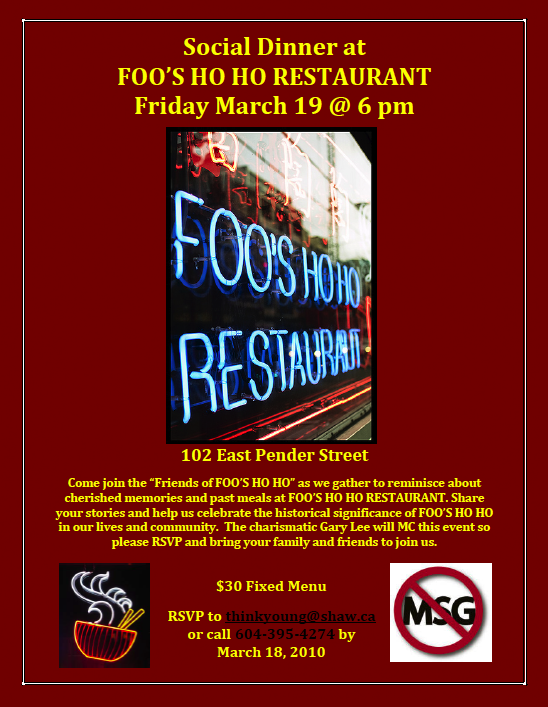
AHA MEDIA is very proud to help announce Social Dinner at Foo’s Ho Ho Restaurant at 6pm on Friday Mar 19, 2010 in Chinatown, Vancouver
AHA MEDIA is very proud to help announce Social Dinner at Foo’s Ho Ho Restaurant at 6pm on Friday Mar 19, 2010 in Chinatown, Vancouver
Come join the “Friends of Foo’s Ho Ho” as we gather to reminisce about cherished memories and past meals at FOO’s HO HO RESTAURANT.
Share your stories and help us celebrate the historical significance of FOO’S HO HO in our lives and community.
The charismatic Gary Lee will MC this event so please RSVP and bring your family and friends to join us.
$30 FIXED MENU
RSVP to thinkyou@shaw.ca or call 604 395-4274 by March 18, 2010
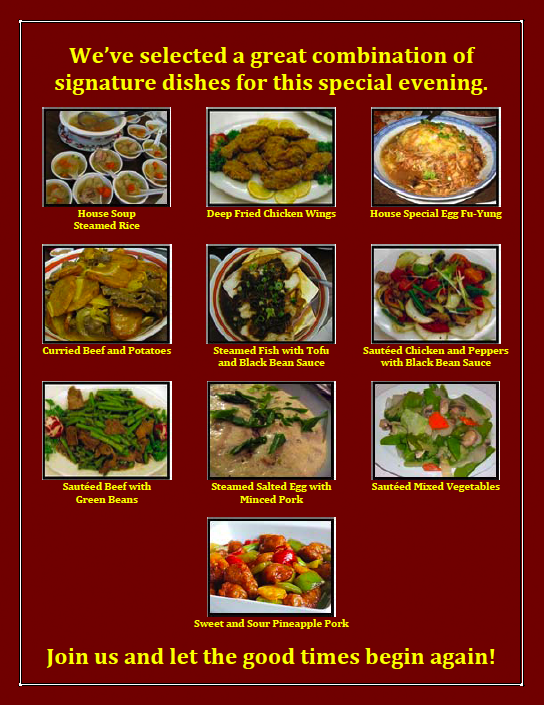
Menu includes:
House Soup
Deep Fried Chicken Wings
House Egg Fu-Yung
Curried Beef and Potato
Steam Fish with ToFu and Black Beans
Sauteed Chicken and Peppers with Black Bean Sauce
Sauteed Beef with Green Beans
Steamed Salted Egg and Minced Pork
Sauteed Mixed Veggies
Steamed Rice
Come join our Facebook event page Social Dinner at Foo’s Ho Ho Restaurant !
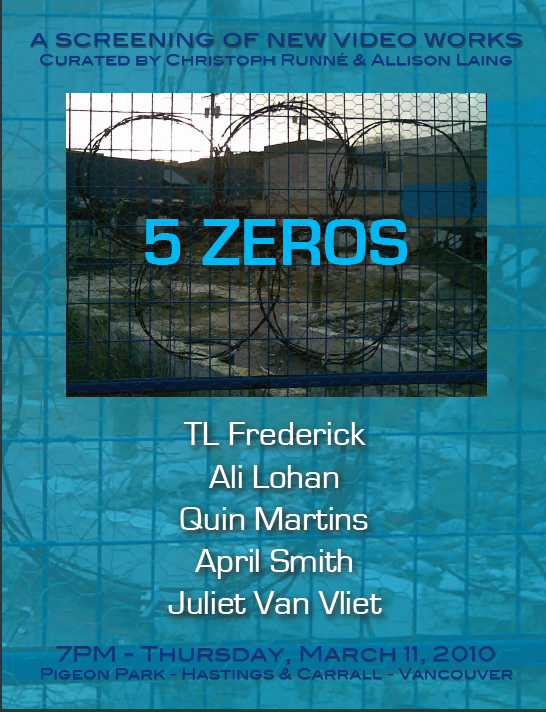
AHA MEDIA is very proud to attend 5 Zeros – A screening of new video works by LifeSkills Collective at 7pm on Thurs March 11, 2010 in Pigeon Park, Vancouver Downtown Eastside (DTES)
AHA MEDIA congratulates the LifeSkills Collective for 5 Zeros – A screening of new video works!
TL Frederick
Ali Lohan
Quin Martins
April Smith
Juliet Van Vliet
and Christoph Runné & Allison Laing!
—————————————————————————————————————————————–
AHA MEDIA is very proud to present at 5 Zeros – A screening of New Video Works in Pigeon Park on Thurs March 11, 2010
The 12 Days of Olympics (2010)
Digital Video, Colour, 8:39 minutes

The 12 Days of Olympics is a short video presented in two parts, both of which offer differing social reactions and unresolved political anxieties associated with poverty, community representation, and the 2010 Winter Olympic Games held in Vancouver, Canada.
Formulated around the familiar Christmas carol, “The Twelve Days of Christmas,” this project anticipates and contextualizes urban-specific dilemmas that pose the greatest threat to some of the most vulnerable members in Vancouver’s Downtown Eastside.
Highlighting issues such as budget cuts, heightened security, seemingly never-ending road closures, corrupt Olympic games, and an “eternal” deficit, while also providing a balancing viewpoint of friendly sports competition and world – wide happy camaraderie that is both insightful and inspiring, this project – which was shot just a few months before the Winter Games – offers two competing and humorous perspectives associated with living in a city that is about to host the Winter Games.
To be sure, the Olympics are not designed for marginalized communities such as Vancouver’s Downtown Eastside, but it is through their unrestrained opinions and curiously contagious enthusiasm that the viewer can acknowledge the inherent contradiction made obvious by the Olympic games themselves: despite attempts to unify the world, this large-scale event, by its very nature, has the reverse effect, because it excludes the majority of the population (most specifically, the poor) from its celebration.
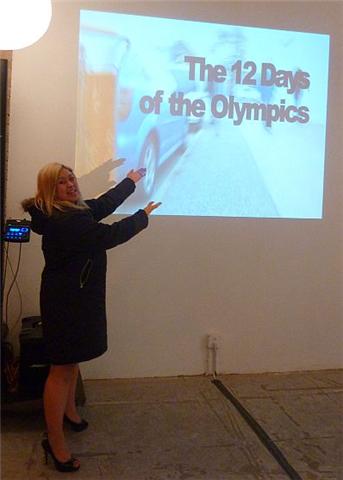
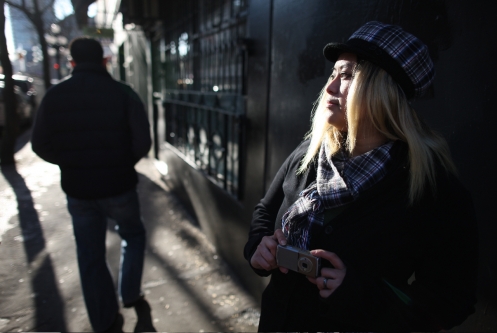
April Smith is a Vancouver-based videographer and documentarian who lives and works in the Downtown Eastside. Through art, music, and community promotion, she is a self-taught advocate for social outreach and neighborhood unity. Using social media, new media, mobile technology, and video, she concentrates on sharing the stories and voices of an otherwise-silenced community with a global audience.
Co-founder of AHA MEDIA, her practice includes educational and political cartooning, facilitating social, new and mobile media literacy workshops, as well as recording subversive and situational observations of her own community. Most recently, her work was published in Megaphone Magazine.
Photo of April Smith by Simon Hayter
April Smith of AHA MEDIA on SWISS TV on how PHS and Woodwards Housing helps her and others with housing, employment and life opportunities in Vancouver Downtown Eastside
In this photo and video, April Smith of AHA MEDIA speaks with SWISS TV on how PHS and Woodwards housing helps her and others in Vancouver Downtown Eastside by providing housing, employment and life opportunities.
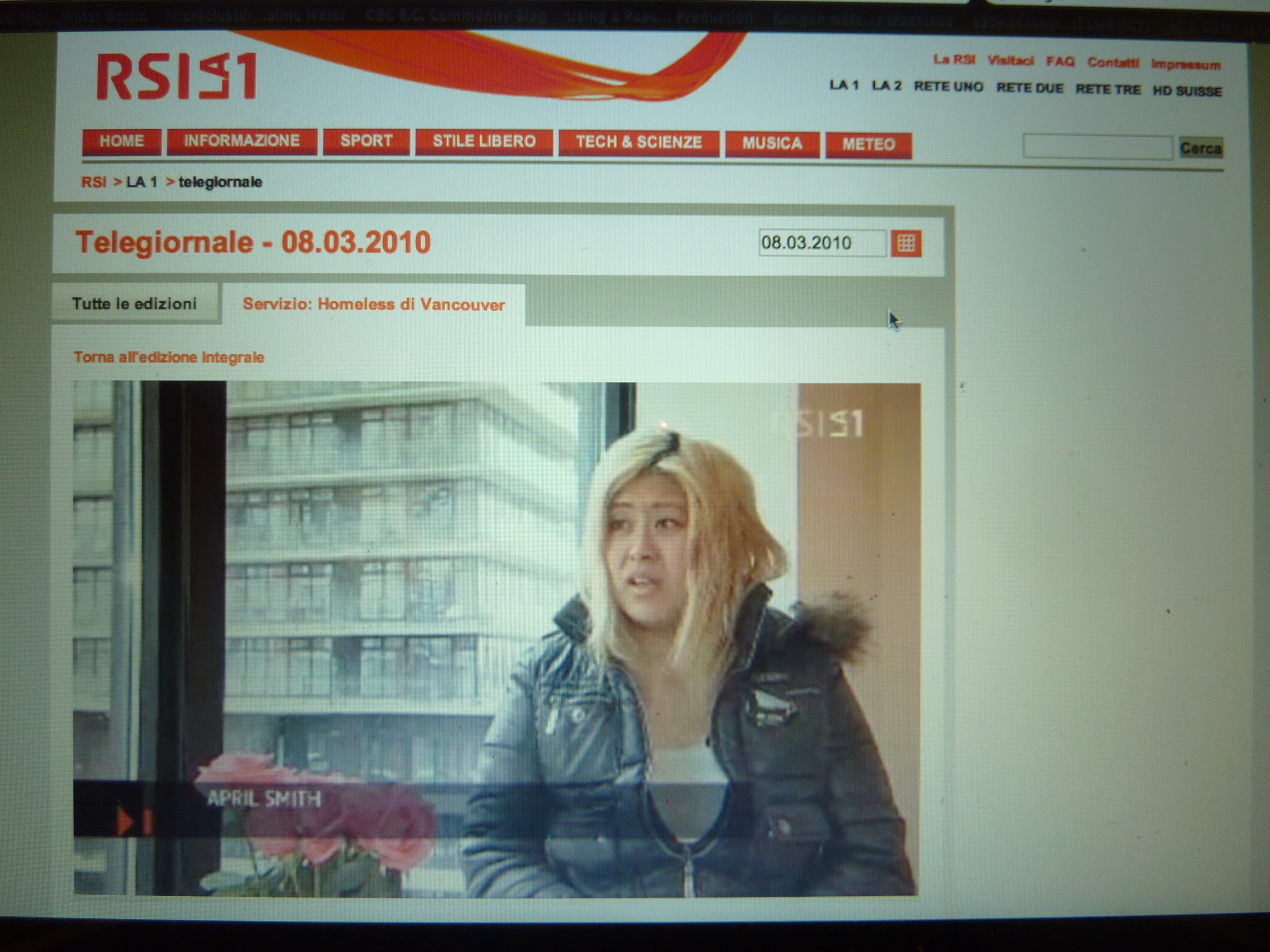
April’s interview highlights the new Woodwards Housing run by PHS and also AHA MEDIA’s new videos ” The 12 Days of Olympics” about life in the Vancouver Downtown Eastside (DTES) and how residents are affected by it
The original link to the story on SWISS TV is here
http://tinyurl.com/yg9cdrl
This video was filmed by April Smith of AHA MEDIA (off the Swiss TV website online http://www.rsi.ch) on a New Media camera – Panasonic DMC-ZS3. AHA MEDIA is about exploring mobile media production through New Media cameras. For a better quality version of this video, please DM April Smith @AprilFilms on Twitter or Facebook.com/AprilFilms
AHA MEDIA from Vancouver Downtown Eastside (DTES) Canada wishes everyone a Happy International Women’s Day today – Monday March 8, 2010
AHA MEDIA from Vancouver Downtown Eastside (DTES) Canada wishes everyone a Happy International Women’s Day today March 8, 2010

http://www.internationalwomensday.com/
http://en.wikipedia.org/wiki/International_Women’s_Day
2010 International Women’s Day
On occasion of 2010 International Women’s Day the International Committee of the Red Cross is drawing attention to the hardship displaced women endure. The displacement of populations is one of the gravest consequences of today’s armed conflicts. It affects women in a host of ways.[3]
Women displaced by armed conflict – often living alone with their children – are frequently exposed to sexual violence, discrimination and intimidation. Many face poverty and social exclusion as well. International humanitarian law therefore includes specific provisions protecting women, for example when they are pregnant or as mothers of young children.[4]
—————————————————————————————————————————————————————–
International Women’s Day has been observed since in the early 1900’s, a time of great expansion and turbulence in the industrialized world that saw booming population growth and the rise of radical ideologies.
1908
Great unrest and critical debate was occurring amongst women. Women’s oppression and inequality was spurring women to become more vocal and active in campaigning for change. Then in 1908, 15,000 women marched through New York City demanding shorter hours, better pay and voting rights.
1909
In accordance with a declaration by the Socialist Party of America, the first National Woman’s Day (NWD) was observed across the United States on 28 February. Women continued to celebrate NWD on the last Sunday of February until 1913.1910
In 1910 a second International Conference of Working Women was held in Copenhagen. A woman named a Clara Zetkin (Leader of the ‘Women’s Office’ for the Social Democratic Party in Germany) tabled the idea of an International Women’s Day. She proposed that every year in every country there should be a celebration on the same day – a Women’s Day – to press for their demands. The conference of over 100 women from 17 countries, representing unions, socialist parties, working women’s clubs, and including the first three women elected to the Finnish parliament, greeted Zetkin’s suggestion with unanimous approval and thus International Women’s Day was the result.1911
Following the decision agreed at Copenhagen in 1911, International Women’s Day (IWD) was honoured the first time in Austria, Denmark, Germany and Switzerland on 19 March. More than one million women and men attended IWD rallies campaigning for women’s rights to work, vote, be trained, to hold public office and end discrimination. However less than a week later on 25 March, the tragic ‘Triangle Fire’ in New York City took the lives of more than 140 working women, most of them Italian and Jewish immigrants. This disastrous event drew significant attention to working conditions and labour legislation in the United States that became a focus of subsequent International Women’s Day events. 1911 also saw women’s ‘Bread and Roses‘ campaign.1913-1914
On the eve of World War I campaigning for peace, Russian women observed their first International Women’s Day on the last Sunday in February 1913. In 1913 following discussions, International Women’s Day was transferred to 8 March and this day has remained the global date for International Wommen’s Day ever since. In 1914 further women across Europe held rallies to campaign against the war and to express women’s solidarity.1917
On the last Sunday of February, Russian women began a strike for “bread and peace” in response to the death over 2 million Russian soldiers in war. Opposed by political leaders the women continued to strike until four days later the Czar was forced to abdicate and the provisional Government granted women the right to vote. The date the women’s strike commenced was Sunday 23 February on the Julian calendar then in use in Russia. This day on the Gregorian calendar in use elsewhere was 8 March.1918 – 1999
Since its birth in the socialist movement, International Women’s Day has grown to become a global day of recognition and celebration across developed and developing countries alike. For decades, IWD has grown from strength to strength annually. For many years the United Nations has held an annual IWD conference to coordinate international efforts for women’s rights and participation in social, political and economic processes. 1975 was designated as ‘International Women’s Year‘ by the United Nations. Women’s organisations and governments around the world have also observed IWD annually on 8 March by holding large-scale events that honour women’s advancement and while diligently reminding of the continued vigilance and action required to ensure that women’s equality is gained and maintained in all aspects of life.2000 and beyond
IWD is now an official holiday in China, Armenia, Russia, Azerbaijan, Belarus, Bulgaria, Kazakhstan, Kyrgyzstan, Macedonia, Moldova, Mongolia, Tajikistan, Ukraine, Uzbekistan and Vietnam. The tradition sees men honouring their mothers, wives, girlfriends, colleagues, etc with flowers and small gifts. In some countries IWD has the equivalent status of Mother’s Day where children give small presents to their mothers and grandmothers.The new millennium has witnessed a significant change and attitudinal shift in both women’s and society’s thoughts about women’s equality and emancipation. Many from a younger generation feel that ‘all the battles have been won for women’ while many feminists from the 1970’s know only too well the longevity and ingrained complexity of patriarchy. With more women in the boardroom, greater equality in legislative rights, and an increased critical mass of women’s visibility as impressive role models in every aspect of life, one could think that women have gained true equality. The unfortunate fact is that women are still not paid equally to that of their male counterparts, women still are not present in equal numbers in business or politics, and globally women’s education, health and the violence against them is worse than that of men.
However, great improvements have been made. We do have female astronauts and prime ministers, school girls are welcomed into university, women can work and have a family, women have real choices. And so the tone and nature of IWD has, for the past few years, moved from being a reminder about the negatives to a celebration of the positives.
Annually on 8 March, thousands of events are held throughout the world to inspire women and celebrate achievements. A global web of rich and diverse local activity connects women from all around the world ranging from political rallies, business conferences, government activities and networking events through to local women’s craft markets, theatric performances, fashion parades and more.
Many global corporations have also started to more actively support IWD by running their own internal events and through supporting external ones. For example, on 8 March search engine and media giant Google some years even changes its logo on its global search pages. Year on year IWD is certainly increasing in status. The United States even designates the whole month of March as ‘Women’s History Month’.
So make a difference, think globally and act locally !! Make everyday International Women’s Day. Do your bit to ensure that the future for girls is bright, equal, safe and rewarding
—————————————————————————————————————————————————–

INTERNATIONAL WOMEN’S DAY CENTENARY 1911 TO 2011
International Women’s Day (IWD) was first declared in 1910 with the first IWD event held in 1911. 2011 sees 100 years of International Women’s Day having been celebrated around the world. Widespread increased activity is anticipated globally on 8 March 2011 honouring 100 years of International Women’s Day.
Vision
To get the whole world behind supporting and celebrating 100 years of International Women’s Day in 2011.
Why
The International Women’s Day Centenary should make the women of past proud, the women of current inspired, and the women of the future envisioned. Women have made great strides in equality yet there is still a great deal to be achieved on many fronts and the 2011 IWD Centenary will provide a unique and global opportunity to reignite, inspire and channel women’s equality for the future.
The challenge
http://www.internationalwomensday.com has been providing a useful service and resources for women, organisations, companies, governments and media all around the world for the past decade – and now we need your help.
How can you get involved?
We would love to hear your ideas, visions, challenges in the lead up to the 2011 IWD Centenary. We are actively looking for global supporters (corporations, charities, media partners, agencies, etc) to assist with the vision. We are calling for Global Partners to support various initiatives and opportunities.
* Establishment of International Women’s Day Foundation
* IWD Centenary global logo competition for girls
* IWD Centenary ‘100 women, 100 stories’ initiative
* IWD Centenary ‘100 women, 100 pictures’ initiative
* Worldwide gender-related “Charity of Choice” for global donations
* Further IWD Centenary opportunities available
Contact
Should your global organisation wish to express interest or initiate conversation, please contact us.
=======================================================================================================
WOMEN’S DAY IN MODERN CULTURE
| International Women’s Day | |
|---|---|
| Observed by | Albania, Algeria, Argentina,Armenia, Azerbaijan,Bangladesh,Belarus,Bhutan,Bosnia and Herzegovina,Brazil, Bulgaria, Burkina Faso,Cambodia, Cameroon, Chile,China, Colombia, Croatia, Cuba,Cyprus, Ecuador, Estonia,Denmark, Finland, Georgia,Greece, Hungary, Iceland, India,Italy, Israel, Laos, Latvia,Lithuania, Kazakhstan, Kosovo,Kyrgyzstan, Macedonia, Malta,Mexico, Moldova, Mongolia,Montenegro, Nepal, Norway,Poland, Portugal, Romania,Russia, Serbia, Slovakia, Slovenia,South Africa, Sweden, Spain,Syria, Taiwan, Tajikistan, Turkey,Turkmenistan, Ukraine,Uzbekistan, Vietnam, Zambia |
The day is an official holiday in Afghanistan, Armenia, Azerbaijan, Belarus, Burkina Faso, Cambodia, China (for women only),Croatia, Cuba, Georgia, Guinea-Bissau, Eritrea, Kazakhstan, Kyrgyzstan, Laos, Madagascar (for women only), Moldova, Mongolia, Montenegro, Nepal (for women only), Russia, Serbia, Tajikistan, Turkmenistan, Uganda, Ukraine, Uzbekistan, Vietnam, and Zambia.
In some countries, such as Cameroon or Romania the day is not a public holiday, but is widely observed nonetheless.
On this day it is customary for men to give the women in their lives – mothers, wives, girlfriends, daughters, colleagues, etc – flowers and small gifts. In some countries (such as Romania) it is also observed as an equivalent of Mother’s Day, where children also give small presents to their mothers and grandmothers.
After the collapse of the Soviet Union celebrations of IWD were abandoned in Armenia. Instead April 7 was introduced as state holiday of ‘Beauty and Motherhood.’ The new holiday immediately got popular among Armenians, as it commemorates one of the main holidays of Armenian Church, Annunciation. However, people still kept celebrating IWD on March 8 as well. Public discussion held on the topic of two ‘Women’s Days’ in Armenia resulted in the recognition of the so called ‘Women’s Month’ which is the period between March 8 and April 7.
In Italy, to celebrate the day, men give yellow mimosas to women. Yellow mimosas and chocolate are also one of the most common March 8 presents in Russia and Albania.
In Bosnia and Herzegovina, Brazil, Croatia, Slovakia, Hungary, Romania, Lithuania, Moldova, Macedonia, Montenegro, Poland, Bulgaria,Slovenia and Serbia the custom of giving women flowers still prevails. Women sometimes get gifts from their employers too. Schoolchildren often bring gifts for their teachers as well.
In countries like Portugal it is usual, at the night of 8 March, for groups of women celebrate in “women-only” dinners and parties.
In India, IWD holds a lot of significance. Many celebrations are held during the day.
In Pakistan working women in formal and informal sectors celebrate International Women’s Day every year to commemorate their ongoing struggle for due rights, despite facing many cultural and religious restrictions. Some women working for change in society use IWM to help the movement for women’s rights. In Poland, for instance, every International Women’s Day includes large feminist demonstrations in major cities.
In 1975, which had been designated as International Women’s Year, the United Nations gave official sanction to and began sponsoring International Women’s Day.
The 2005 Congress (conference) of the British Trades Union Congress overwhelmingly approved a resolution calling for IWD to be designated a public holiday in the United Kingdom.
Since 2005 International Women’s Day has been celebrated in Montevideo, either on the principal street, 18 de Julio, or alternatively through one of its neighbourhoods. The event has attracted much publicity due to a group of female drummers, La Melaza, who have performed each year.
Today many events are held by women’s groups around the world. The UK based Marketing company, Aurora hosts a free worldwide register of IWD local events so that women and the media can locate local activity. Many governments and organizations around the world support IWD.
Follow Us!


 AHA Media