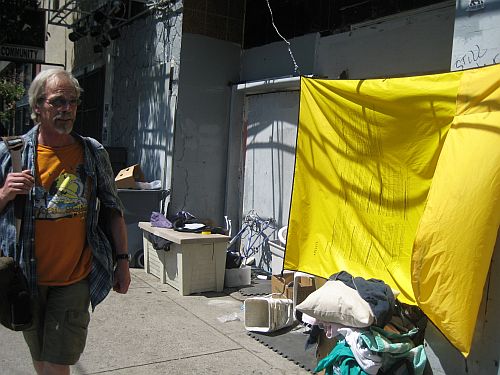
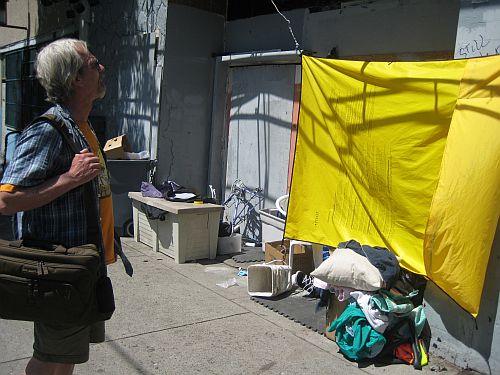
AHA MEDIA sees PIVOT’s Rights Blanket being used on East Hastings street in Vancouver Downtown Eastside
http://www.pivotlegal.org/News/07-12-17–RightsBlanket.html
Pivot and MEC to blanket homeless with legal rights
Vancouver – December 17, 2007
Tomorrow (Tuesday) afternoon, Pivot Legal Society will begin giving away the first run of its new Rights Blanket to homeless individuals living in the Downtown Eastside.
The high-tech Blanket, co-designed and produced by Mountain Equipment Coop, is designed for homeless people, made of waterproof dernier nylon and features a printed list of people’s rights in relation to housing, security guards, police and welfare.
“We wanted to create a product that would be not only useful on the practical level for someone living on the streets, but also effective as way of informing people about their rights under the law,” said John Richardson, executive director of Pivot Legal Society.
A joint project between Mountain Equipment Coop and Pivot, the Rights Blanket is light-weight, rugged, and easy to pack. Made of the same material as MEC’s high-end rainjackets, the Rights Blanket acts like a large, light-weight tarp with footpockets, drawstrings and a built-in stuffsack. It wraps around a sleeping person, their clothing and insulating blankets, protecting them from water and wind. Silk-screened onto the inside of the Blanket, in 26 point font, are various need-to-know rights for homeless people, including their rights in relation to panhandling, security guards, housing, policing, and welfare.
RIGHTS BLANKET
Read article Pivot and MEC to blanket homeless with legal rights
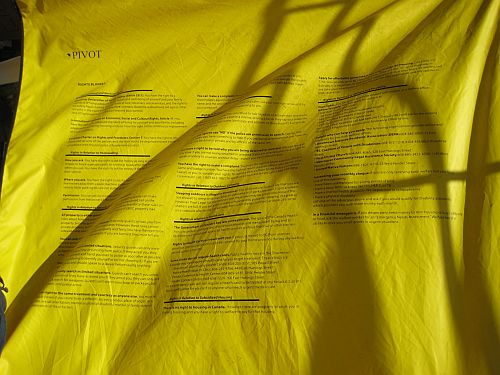
International and National Rights
Universal Declaration of Human Rights, Article 25(1): You have the right to a standard of living adequate for the health and well-being of yourself and your family including food, clothing, housing, medical care, necessary social services, and the right to security in the event of unemployment, sickness, disability, widowhood, old age or other lack of livelihood in circumstances beyond your control.
International Covenant on Economic, Social and Cultural Rights, Article 11: You have the right to an adequate standard of living for yourself and your family; including adequate food, clothing, housing and you have the right to the continuous improvement of living conditions.
Canadian Charter on Rights and Freedoms, Section 7: You have the right to life, liberty and security of the person; and the right not to be deprived thereof except in accordance with the principles of fundamental justice.
Rights in Relation to Panhandling
How you ask. You have the right to ask for money as long as you do not swear or make threats, or block a person’s path, or continue to ask after they have said no.
When you ask. You have the right to ask for money if the person is alone and away from their vehicle.
Where you ask. You have the right to ask for money on public property if the person is five metres away from a bank machine, public pay phone, public bathroom, or bus stop or vehicle. Note: parking lots are not public property.
Permission. You can ask for money within five meters of a bank machine if you have permission from the owner of the property where the bank machine is located.
Rights in Relation to Security Guards
All property is either private or public. The owner of PRIVATE property can make rules about how it is used and what activities are allowed to be carried out on the property. Security guards can have the authority of the owner to enforce these rules on private property, but they have no power to enforce rules on PUBLIC property (like sidewalks and alleys).
You can only be banned from “private” property. A security guard can ban you from private property if you don’t obey the rules of the owner. However, these rules cannot discriminate and must be applied to everyone equally and fairly. You have the right to be judged by your actions, but not your appearance. If you are banned, they must tell you why.
Security guards can only arrest in limited situations. Security guards can only arrest you if they see you committing a crime or running from police. If they arrest you, they must tell you why you are arrested and hand you over to police as soon after as possible. Guards can’t arrest you for refusing to identify yourself or for not showing ID. If you are arrested, you have a right to, and should, speak to a lawyer before saying anything.
Security guards can only search in limited situations. Guards can’t search you unless you give them permission or they have arrested you. If they arrest you, they can only do a pat-down or quick search for weapons. Guards can’t search your bags or packages, but they can hold them until police arrive.
You have the right to the same treatment and courtesy as anyone else. You must be treated equally even if you come from a different ancestry, colour, place of origin, race, religion, sex, sexual orientation, mental or physical disability, marital or family status or any combination of these factors.
You can make a complaint. You can report a guard that abuses you, swears at you, discriminates against you or violates your rights. It’s important that you get the guard’s name, and the security company they work for. You can call 1-877-689-8474 to make your complaint.
Rights in Relation to Police
If you are arrested by the police: stay SILENT and calm, use your common sense and try to remember your rights and what is happening to you.
You have the right to silence. You can refuse to talk to police or answer their questions. The exceptions are if you are in a bar or a cinema, driving a car, or they say you broke the law, then you must give your name, birth date and address, or show your ID, but you do not have to say any more.
You have the right to say “NO” if the police ask permission to search. Saying “NO” does not mean you have something to hide. If you are being strip-searched, you have the right for it to be done in private and by officers of the same sex.
You have a right to be told why you are being detained or arrested. You can leave at any time if you are not being detained or arrested. If you are arrested, you have a right to speak privately to a lawyer without delay – even if you can’t afford to pay.
You have the right to make a complaint. You have the right to know a police officer’s name and badge number. You have the right to report a police officer who abuses you, swears at you, or violates your rights. To report a police officer to the Police Complaint Commission call: 1-800-663-7867. To speak to a Legal Aid lawyer call: 1-888-978-0050
Rights in Relation to Outdoor Camping
Sleeping outdoors is illegal in Vancouver. City of Vancouver bylaws say that you are not allowed to sleep or set up camp on sidewalks or in parks. However, Pivot Legal Society believes that these laws may be unconstitutional if the shelters are full. If you are given a ticket for sleeping in a park after being turned away from a full shelter, call Pivot at (604) 255-9700.
Rights in relation to health care
The Government of Canada’s key law on healthcare. The goal of the Canada Health Act is: to protect, promote and restore your physical and mental well-being and to facilitate your reasonable access to health services without financial or other barriers.
Rights to Health Services travel with you. If you just moved to BC from another province, then you will continue to be covered by your home province during any waiting period under 3 months.
Some clinics do not require health cards. Public health clinics in the Downtown Eastside may not require a health card for you to get treatment. These clinics are:
Downtown Community Health Centre: 604-255-3151, 569 Powell Street.
Native Health Walk-In Clinic: 604-255-9766, 449 East Hastings Street.
Pender Community Health Centre: 604-669-9181, 59 W. Pender Street
Health Contact Centre: 604-658-1224, 166 East Hastings Street
In an emergency, you will not require a health card to be treated at any hospital. Call 911 for an ambulance for yourself or anyone who needs urgent medical care.
Rights in Relation to Subsidized Housing
There is no right to housing in Canada. However, there are programs to assist you in finding housing, and you have a right to welfare to pay for that housing.
Apply for affordable government housing through BC Housing. Call 1-800-257-7756. You can also go to BC Housing Home Office at Suite 101, 4555 Kingsway, in Burnaby. It is important to update your application at least once every six months, and any time your information changes. You can fax your application and any updates to (604) 439-4729.
Rights in Relation to Welfare and Disability
Your rights. You have the right to be treated with respect at a welfare office.
Where to apply. You can apply for welfare at:
- 180 Main Street (Dockside)
- 205 Powell Street (Kiwassa)
- 687 Powell Street (Strathcona Mental Health)
- #201-475 East Broadway (China Creek)
- 2350 Commercial Drive (Grandview)
For other office locations call 604 660-2421 (Enquiry BC) and ask for the nearest Ministry of Employment and Income Assistance Office to you.
People who can help you apply. The following organizations provide advice and advocacy for you with welfare offices:
- Downtown Eastside Residents’ Association (DERA) 604-682-0931, 12 East Hastings Street.
- BC Coalition of People with Disabilities 604-872-1278, #204-456 West Broadway Street.
- First United Church 604-681-8365, 320 East Hastings Street.
- Vancouver Community Legal Assistance Society 604-685-3425, #300-1140 West Pender Street.
- United Native Nations 688-1821, #110-23 West Pender Street.
Increasing your monthly cheque. If you are only receiving basic welfare but you have one of the following:
- have been unemployed for a long period of time
- have a long-term sickness like HIV, HEP C, or TB
- have a mental health disability like depression or schizophrenia
- have a physical disability
call one of the advocates above and ask if you would qualify for disability assistance, which provides you with more money each month.
In a financial emergency. If you desperately need money to rent housing or buy clothing or food, ask the welfare worker for an “Emergency Needs Assessment.” Welfare has the ability to give you small grants in urgent situations.
Follow Us!


 AHA Media