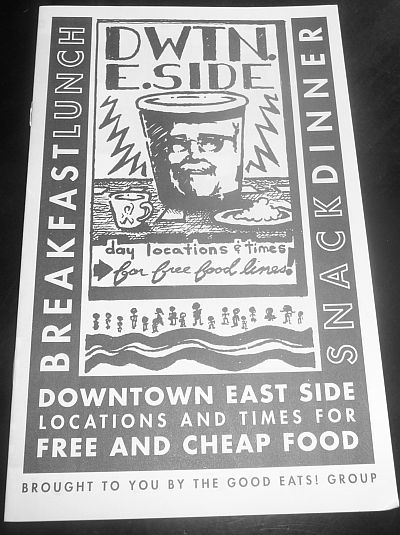
Foodline – a map of 2009 Vancouver Downtown East Side locations to eat free and cheap food
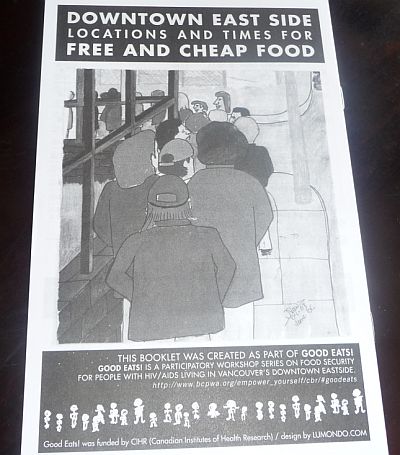
Foodline is a map of 2009 Downtown East Side Locations to eat free and cheap food.
Feel free to print it out and distribute it.
It was prepared by the Good Eats peer researchers and artists from the LifeSkills Centre.
[ View Foodline ]
GOOD EATS! 2008
What is it? , What happened? & Who participated?
Was a participatory workshop series about food security in the context of HIV in the Downtown East Side of Vancouver (DTES). After a community mapping meeting with stakeholders on March 19th, 2008 a series of 10 workshops with DTES HIV+ participants generated much knowledge. Participants and facilitators engaged in open and frank guided conversations and mapping of the DTES – what, where and how is possible to find sustenance in the area and related issues (e.g. nutritional value, cost, etc.). The participants – who were offered a gradually ascendant stipend scale – also cooked fresh, inexpensive and highly nutritional meals with local nutritionists and community based cooks and sat to eat as a group. Also, they visited the Quest food exchange www.questoutreach.org, a community garden and a local non-commercial radio show in Coop radio. The group dynamics of a widely varied number of people from rough paths of life attending the Good Eats! workshops was successful; this shows that food is a great socializing agent. To close the series, a final stakeholders/participants meeting was scheduled for June 2008 at the LifeSkills Centre.
What we found out?
Some preliminary findings: women and transgendered persons male to female living with HIV seem to be able to find more food resources available and less sleeping/shelter resources than men. When food is available, participants often do not have the basic facilities to cook and refrigerate/freeze. Individually, eating is difficult to organize in the presence of drug use or poor health conditions (e.g. lack of teeth). The nutrition value per se may take a second place to personal preferences such as convenience of location, how well a person is treated in a free food delivery place, and the value of comfort food (the emotional component of food). Tellingly, one participant told us “they say one cannot live on bread and water, but we do in the DTES”. In many ways, HIV+ persons in the DTES behave much like any regular “consumer” even if there is a cultural expectation that they behave as docile charity recipients. When there is money, HIV+ persons do use low-paid food places that offer good choices. When there is no money to buy food, stealing, “binning” and lining up for food is necessary, sometimes in places where they are “red zoned” by the local police and pulled from the queue if identified. “Binning” is good when food outlets (especially upscale ones) turn a blind eye to city regulations and pack expensive leftovers and leave them strategically to be picked up. Participants identified a few faith-based places they must pray for their meal; coercion may still be a part of social food delivery. Also, participants told us that if they had a chance, most of them would rather work for their food either legally or under the table.
Who worked on this project?
Our Community Based Research (CBR) team: Shane Turner, the LifeSkills Centre Coordinator, Christiana Miewald, Food Researcher at SFU, Tanya Palazzo, Volunteer BCPWA (podcasts and notes) and Francisco Ibáñez-Carrasco HIV/AIDS Community Based Research Facilitator (BCPWA). This activity is funded through in-kind work of volunteers, the CBR program, the Centre for Sustainable Community Development at SFU and a Community Based Research grant from the Canadian Institutes of Health Research.
Follow Us!


 AHA Media